


GHK-Cu Peptide for Skin Rejuvenation: Collagen Production and Anti-Aging
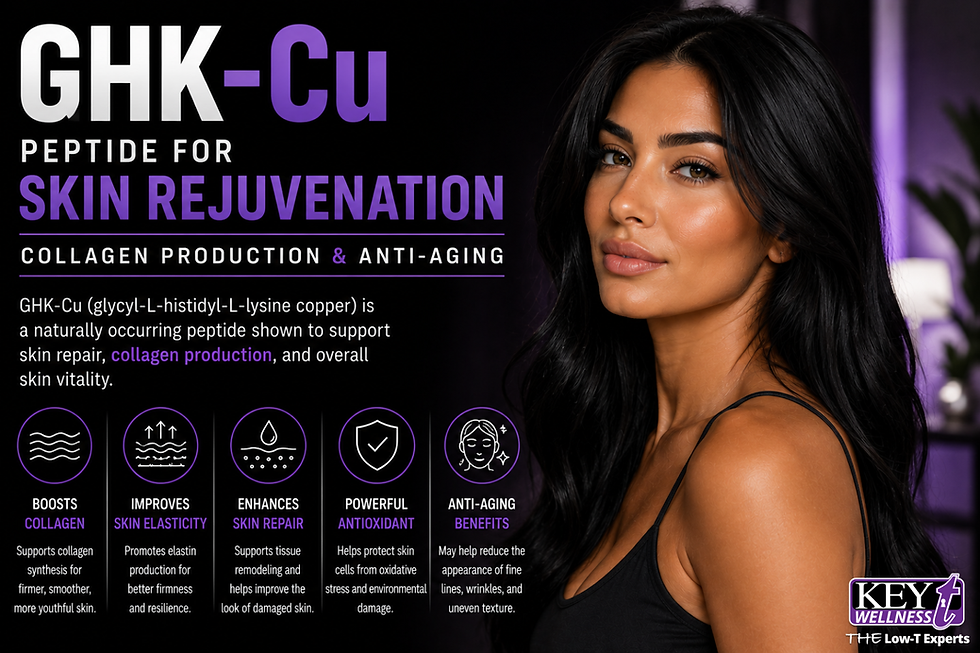
GHK-Cu
Healthy, youthful-looking skin depends heavily on its underlying structure. As collagen and elastin change with age, skin can gradually become thinner, less firm, and more prone to fine lines and wrinkles.
That has created growing interest in GHK-Cu, commonly called the copper peptide, for its potential role in skin rejuvenation, tissue remodeling, and collagen production.
Unlike many ingredients marketed purely around cosmetic appearance, GHK-Cu has been studied for its biological activity within skin. Research suggests it can influence fibroblasts, collagen synthesis, extracellular-matrix remodeling, and other processes involved in skin repair. However, the clinical evidence is still limited compared with established dermatologic anti-aging treatments.
What Is GHK-Cu?
GHK-Cu stands for glycyl-L-histidyl-L-lysine copper.
GHK is a naturally occurring three-amino-acid peptide found in the human body. It has a strong affinity for copper ions, forming the complex known as GHK-Cu.
Researchers have been interested in GHK-Cu because of its involvement in biological processes associated with:
Collagen synthesis
Elastin production
Tissue remodeling
Fibroblast activity
Skin repair
Inflammatory signaling
Antioxidant activity
Research has shown that GHK-Cu can stimulate collagen synthesis in fibroblasts, which are cells responsible for producing much of the skin's structural extracellular matrix.
GHK-Cu and Collagen Production
One of the biggest reasons GHK-Cu has gained attention in skincare is its relationship with collagen production.
Collagen provides structural support to the skin. As we age, changes in collagen production and degradation contribute to many visible signs of aging.
Laboratory research has demonstrated that GHK-Cu can stimulate collagen synthesis in fibroblast cultures. Research has also associated the peptide with increased production of elastin and other components involved in tissue remodeling.
This provides a biological rationale for investigating GHK-Cu as a skin-rejuvenation ingredient.
Can GHK-Cu Help With Anti-Aging?
GHK-Cu is frequently described as an anti-aging peptide, but it is important to understand what that term means.
It doesn't stop or reverse biological aging.
Instead, research has examined whether GHK-Cu may improve some of the visible characteristics associated with aging skin.
Published reviews describe studies in which topical GHK-Cu formulations were associated with improvements in measures such as skin density, thickness, firmness, fine lines, and wrinkle appearance.
A recent systematic review of GHK-Cu in aesthetic medicine found a plausible biological basis for regenerative applications but also emphasized that much of the evidence remains preclinical and that there are relatively few well-designed human clinical trials.
So while GHK-Cu is promising, claims should remain proportional to the evidence.
GHK-Cu and Skin Rejuvenation
Skin rejuvenation isn't determined by one biological process.
Healthy skin involves collagen and elastin, hydration, cellular turnover, extracellular-matrix integrity, inflammation, oxidative stress, and the skin barrier.
GHK-Cu is particularly interesting because research suggests its activity isn't limited to a single pathway.
Studies have associated GHK-Cu with extracellular-matrix remodeling and cellular processes involving fibroblasts and keratinocytes—the cells that play important roles in skin structure and renewal.
This broader biological activity is one reason copper peptides have become increasingly common in cosmetic skincare.
GHK-Cu for Fine Lines and Wrinkles
Fine lines and wrinkles develop partly because the skin's structural support changes with age and environmental exposure.
Because GHK-Cu has been associated with collagen synthesis and tissue remodeling, researchers have studied whether topical formulations can improve the appearance of aging skin.
Some studies summarized in the scientific literature have reported improvements in wrinkle depth, fine lines, skin density, and skin thickness following topical GHK-Cu use.
But not every clinical study has demonstrated an objective benefit.
For example, a randomized trial involving 13 patients after CO2 laser resurfacing found no significant objective difference in wrinkles or overall skin quality between treatment groups, although patients using the GHK-Cu products reported greater satisfaction with their skin quality.
That mixed evidence is important when evaluating anti-aging claims.
GHK-Cu and Elastin
Collagen gets most of the attention in skincare, but elastin is another important structural protein.
As its name suggests, elastin contributes to the skin's ability to stretch and return toward its original shape.
Research reviewed in the scientific literature suggests GHK-Cu can influence both collagen and elastin production in human dermal fibroblasts.
The potential influence on multiple components of the extracellular matrix makes GHK-Cu particularly interesting for research into skin quality rather than simply wrinkle appearance.
GHK-Cu and Skin Repair
GHK-Cu was studied for tissue repair long before copper peptides became a popular skincare trend.
Research has associated GHK-Cu with processes involved in wound healing and tissue remodeling, including fibroblast activity, angiogenesis, collagen production, and inflammatory responses.
Research in this area continues.
A Phase 2 randomized, double-blind study registered in 2026 is evaluating a topical GHK-Cu gel for healing standardized skin wounds in healthy adults. The study is recruiting and does not yet have efficacy results, so it should not be interpreted as proof that the treatment works for this purpose.
Topical GHK-Cu vs Other Forms
This distinction is especially important.
Much of the human cosmetic research surrounding GHK-Cu involves topical formulations applied directly to the skin.
Evidence supporting one formulation or delivery method cannot automatically be applied to every other method of using GHK-Cu.
Products can also differ considerably in concentration, formulation, stability, delivery system, and intended use.
Patients interested in GHK-Cu should therefore avoid assuming that every product marketed as a "copper peptide" will produce the same effects seen in research.
How Long Does GHK-Cu Take to Work?
Skin remodeling doesn't happen overnight.
Several of the studies discussed in published reviews evaluated topical GHK-Cu over periods of approximately 8–12 weeks, rather than a few days.
Individual results can vary substantially depending on factors such as age, skin condition, sun exposure, skincare routine, formulation, and the specific treatment being used.
Promises of dramatic or immediate rejuvenation should therefore be viewed cautiously.
Is GHK-Cu Right for Everyone?
Not necessarily.
Just because a compound occurs naturally in the body doesn't automatically mean every formulation or method of administration is appropriate for every person.
Someone considering GHK-Cu should understand exactly:
What formulation is being considered
How it is intended to be used
What evidence supports that use
Potential risks or side effects
Whether other treatments may be more appropriate
What realistic results might look like
This is especially important when moving beyond conventional topical cosmetic products into treatments marketed as peptide therapy.
GHK-Cu, Collagen Production, and Anti-Aging
GHK-Cu occupies an interesting position in modern skincare.
There is legitimate scientific evidence supporting its biological activity, particularly involving collagen production, fibroblast activity, and extracellular-matrix remodeling. There are also human studies suggesting potential cosmetic benefits.
At the same time, a 2026 systematic review concluded that the clinical evidence remains constrained by methodological differences and a limited number of high-quality trials.
Larger controlled studies are still needed.
The best way to think about GHK-Cu, therefore, isn't as a miracle anti-aging solution.
It's a biologically interesting copper peptide with promising skin-rejuvenation research that continues to be investigated.
Learn More About GHK-Cu at Key T Wellness
At Key T Wellness, we believe wellness treatments should begin with education and individualized guidance rather than trends or exaggerated promises.
If you're interested in GHK-Cu, skin rejuvenation, collagen support, or other peptide-related wellness options, a consultation provides an opportunity to discuss your goals and better understand the available approaches.


Comments